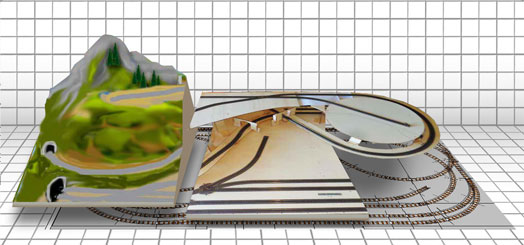
The basic elements of the model train layout
Various considerations on the elements of the model train layout and how they influence the choice of the track plan and the entire project.
The station

In a model railway layout, there must obviously be at least one station.
A small secondary or mountain station can be built with a certain degree of realism; however, if we want to include a large city station or a major railway junction, we simply do not have enough space.
In this case, the only solution is to place the station close to the edge of the layout, letting the viewer imagine that the station area continues to expand outside of our small world.

With a little creativity, it is possible to fit a few turnouts, double tracks, and a couple of passenger platforms into a small space to allow some train consists to stop and perform simple maneuvers. Usually, a consist is formed of at least 3 coaches (even though there would be more in reality), which means that to enter the station, the track should be at least 130 cm long.
The Fiddle Yard (Hidden Station)
This bizarre name refers to all those track sections hidden by the scenery whose purpose is to allow some train consists to stage or park while others are running in full view.

Building a hidden fiddle yard usually involves utilizing a lower deck or staging level beneath the main layout, completely out of sight, using gradients and ramps to move trains up and down from the visible sections.
Verifica il prezzo su Amazon e Ordina un avvitatore elettrico consigliato.
The main challenges to address are the following:
- (obviously) the layout of the hidden staging tracks and their connections to the rest of the layout, respecting maximum gradients and clearance spaces.
- a control system for turnouts and trains that cannot be seen.
- maintenance access to the hidden area to retrieve derailed rolling stock, etc…
More generally, a ‘Fiddle Yard’ can be understood as any hidden track staging area dedicated to storing trains off-scene.
The underground station
An element that allows saving space while creating the opportunity to feature interesting scenes is the inclusion of an underground station section visible as a cross-section cutaway, naturally along the edge of the layout. In this way, you can increase the number of tracks and pathways, thereby expanding track plan variety by exploiting the space underneath the main baseline level.
In the underground station section, the same trains that arrive on the surface can run, or you can feature trams, subways, shuttle trains, and special consists just as it happens in many major city terminals… …on the other hand, it would be hard to imagine an underground station for a small mountain village!