Scenery
The city in model railroading

If there is a medium or large-sized station (or part of it) on our layout, we will necessarily have a city area as well. Since an entire city cannot fit, we must make it appear to expand through the use of appropriate backdrops.
Let’s remember that if we cannot manage to hide some track sections from view due to lack of space, we can always run them behind a backdrop.
Mountains in the model railway layout

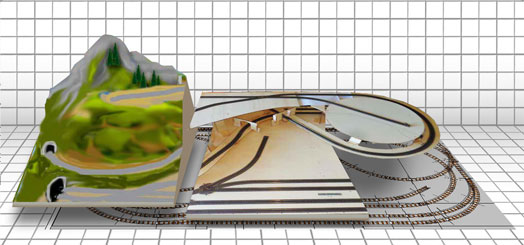
Mountains are an essential part of the layout, whether they are traversed by climbing and descending trains, cut through by tunnels, or simply serve as a background scenery.
In a dedicated section, we look at the different techniques for building mountains, which usually form part of the layout’s framework structure.
On this page, we explore some considerations on how to design mountains on our layout.
While it is true that tracks are straight elements or circular arcs, we should avoid giving mountains exact geometric shapes derived straight from the track plan.

Verifica il prezzo su Amazon e Ordina un avvitatore elettrico consigliato.
We often see layouts with perfectly circular, symmetrical, figure-eight-shaped hills… meaning identical to the shape of the tracks!
Let’s avoid such situations and instead build mountains and hills with irregular shapes, which ‘man’ has then adapted to railway requirements with cuttings, tunnels, retaining walls, bridges, and various kinds of civil engineering works.
If the mountains are located in the background, the rear section can remain open, thus accessible for maintenance on hidden tracks inside tunnels or in staging yards (fiddle yards).
If, on the other hand, the mountain is in the center of the layout, a few more clever arrangements will be needed to access the hidden parts from underneath the baseboard.
Removable mountain sections are often used in case of necessity.