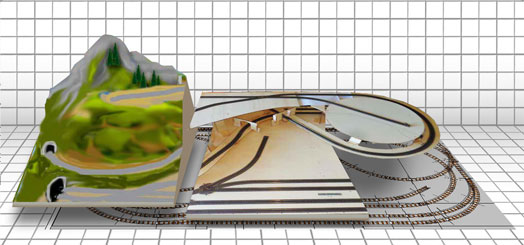
Choosing the Scale for the model railway layout
The H0 Scale (1/87 scale) is the most widespread and offers the greatest variety of products on the market.
For this reason, the H0 Scale is definitely the most economical, given that there are brands and products in all price ranges. In addition, its wide popularity makes it easy to find second-hand items.
The H0 scale is also quite an easy scale, because the dimensions of the various “in scale” parts (houses, trees, figures, cars…) are still large enough that it is fairly simple to glue, assemble, paint, and scratch-build.
This also allows us a certain cost-effectiveness in the choice of work tools, glues, paints, and so on.
The H0 Scale is also the most suitable for involving and entertaining children (first as spectators… up to becoming real helpers!).
Unfortunately, we will have some limitations to our inventiveness due to the dimensions, since the minimum size for an H0 Scale layout is still at least 1 meter x 1.6 meters (this aspect will be explored later).
In fact, compared to smaller scales such as N scale or TT scale, the H0 scale still requires a larger layout size, meaning that, for the same subject, an N layout (1:160) is about half the size of an H0 layout (1:87).
All other aspects, however, favor the H0 scale (cost-effectiveness and ease of use).
An advantage of the N scale is that to make a layout, instead of having to ‘clear a room’, it is enough to make room on the table! For example, our Easy 2 layout, which in H0 scale occupies about 215×160 cm, in N Scale occupies 120x80cm, a size that is much more easily adaptable to small environments.
Although there are no substantial technological differences between H0 Scale and N Scale, the fact that N scale trains are smaller certainly makes certain operations a bit more difficult.
For example, it is advisable to convert to digital only those locomotives that were built ready for mini-decoders and, except in rare cases, it is unthinkable to insert a sound decoder and speaker.
For the rest, turnout operation, transformers, digital command stations, etc… are the same as for the H0 scale.
Let’s make a comparison
The choice between H0 Scale (1:87) and N Scale (1:160) is one of the fundamental crossroads for every model railroader. For those who decide to base their layout in Italy (reproducing the State Railways – FS), this decision entails very specific trade-offs related to the availability of models, the space in Italian homes, and our national modeling culture.
Verifica il prezzo su Amazon e Ordina un avvitatore elettrico consigliato.
Here is a detailed comparison of the pros and cons of the two scales analyzed through the lens of the Italian modeler.
H0 Scale (1:87) – The National Standard
The H0 scale is the undisputed queen of the Italian market. It offers the maximum realism in details and is supported by dozens of manufacturers reproducing the history of our railways.
👍 Pros (H0)
- Immense availability of FS rolling stock: This is the real strong point. You can find anything: from the historic Gr. 740 steam locomotives, to the legendary electric trainsets (Settebello, Arlecchino), up to the modern Frecciarossa and Italo. Brands like Acme, Rivarossi Lima, Roco, Os.Kar, and Vitrains continuously roll out perfect Italian models.
- Extreme detail and realism: The dimensions allow for the reproduction of tiny lettering, photo-etched plates, illuminated coach interiors with passengers, and exceptional bogie details.
- Operation and current collection: Since the models are heavier and have a larger wheel-to-rail contact surface, they are much less affected by dust on the tracks. Low-speed running (shunting) is smooth and flawless.
- Ease of digital conversion and sound: Installing digital decoders or sound modules is very easy thanks to the ample internal space in the locomotives. Many models come already equipped with high-quality integrated speakers.
- Endless second-hand market: On online platforms, flea markets, and swap meets in Italy, you can find an infinite amount of H0 material at prices for all budgets.
👎 Cons (H0)
- Large footprint: This is the historical drawback. To make a realistic curve that does not look like a toy, radii of at least 50-60 cm are needed (a circle takes up more than a meter in width). A medium-sized Italian station with a train of 5-6 passenger coaches easily requires 3 or 4 meters in length.
- Prices of new models: The level of detail comes at a cost. A modern articulated FS locomotive (such as an E.656 or E.646) new and digitalized can easily exceed €300.
N Scale (1:160) – The Power of Space
The N scale reduces dimensions by about half compared to H0. It is the choice for those who want to see the train integrated into the landscape, but for an Italian setting, it requires a more “pioneering” spirit.
👍 Pros (N Scale)
- The landscape dominates over the train: In a space where in H0 you would struggle to run an oval, in N scale you can reproduce a double-track line that runs through hills, viaducts, tunnels, and a complete station. Long trains (e.g., 20-wagon freight trainsets or complete Intercity trains) achieve an unbeatable scenic realism.
- Optimization of home space: A complete and entertaining layout can fit on a desk or on a 150×80 cm panel, easily stored under a bed or hung on the wall.
- Realistic track geometry: Even when using tight radius curves for space reasons, the visual impact is less “fake” compared to H0, because the train is very small compared to its surroundings.
👎 Cons (N Scale)
- Scarcity of industrial FS models: This is the major hurdle for those who love Italian trains. Major brands like Arnold, Fleischmann, or MiniTrix produce Italian rolling stock very sparingly. Fortunately, in recent years, brands like Pi.R.A.T.A. (specialized in Italian N scale) and local artisans are filling the gap, but the choice remains a fraction compared to H0.
- Sensitivity to dust: The locomotives are light and the wheels are tiny. A grain of dust or a track that is not perfectly clean can cause annoying jerks, stalling, or loss of electrical contact, especially over turnouts.
- Complex maintenance and digital conversion: Working on motors or installing tiny decoders requires a steady hand, magnifying glasses, and excellent soldering skills (even though modern models now have Next18 or PluX digital sockets). Models with “sound” are rare, and the sound effect is limited by the small size of the speaker resonance boxes. However, N scale is improving in this aspect.
Direct Comparison Table (FS / Italy Perspective)
| Feature | H0 Scale (1:87) | N Scale (1:160) |
|---|---|---|
| Space required | High (Requires a room or a large perimeter) | Low (Ideal for modern apartments) |
| Italian FS Catalog | Endless (All eras, brands, and prices) | Limited (Focused on the most famous trainsets, a lot of resin/craftsmanship) |
| Trainset realism | Excellent on single details of the train | Excellent on the overall view of the train in the landscape |
| Electrical reliability | Excellent, heavy trains clean the rail | Delicate, requires pristine tracks at all times |
| Ease of Detailing/Kitbashing | High (excellent for scratch-building and weathering) | Medium/Low (requires surgeon-like tools) |
The Italian modeler’s verdict
- Choose H0 Scale if: For you, the train is the absolute protagonist. If you want to collect masterpieces of the Italian railway industry, love interior details, realistic sound, want to turn on the layout and watch it run without going crazy cleaning the tracks, and you have a room, a garage, or a basement available.
- Choose N Scale if: Your dream is to see a long passenger or freight train winding through typical landscapes of the Apennines or Italian coasts, but you only have a bedroom or a corner of the living room available. You must be ready, however, to look for Italian models with more patience (often turning to small producers or the artisan market).
To help you better focus on your project:
- What is the maximum size of the space you could dedicate to the layout at home?
- Is there an Italian railway era that fascinates you the most? (Example: the era of steam and three-phase traction, the ’70s/’80s of Gran Confort coaches, or the modern High-Speed era?)